Who runs Alloy
The team
The team is Keith Bourne and the 10 agents that build and run Alloy.
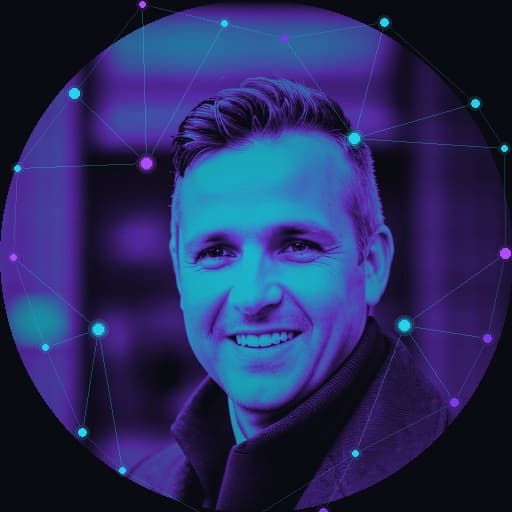
Keith Bourne
Founder, CAO, advisor.
The e-learning organisation
In 2002, the Sloan Consortium (Sloan-C) brought Keith on as Marketing Director and later promoted him to Chief Operations Officer. In those roles, he helped transform the organization from a collection of scattered research projects into the powerhouse in online education it is today. His leadership drove marketing and technical innovation, as well as data-informed product growth, helping Sloan-C expand from 180 member institutions to more than 1,800—representing approximately 80% of the market—along with more than 200 corporate training divisions. During this period, annual revenues grew from $0 to $1.5 million, while grant funding increased from $20,000 to $12 million.
Now known as the Online Learning Consortium, Sloan-C was a nonprofit start-up positioned at the center of the technological revolution transforming education in the early 2000s. The organization explored new ways to extend education to previously hard-to-reach communities, embracing emerging technologies ranging from mobile platforms to innovative software and online learning systems.
He also played a key role in the Sloan Semester, a landmark 2005 emergency initiative that used online education to replace courses for tens of thousands of students displaced by Hurricanes Katrina and Rita. The effort demonstrated the potential of online learning not only as an emerging technology, but as a powerful and immediate solution to large-scale disruptions in traditional education.
Research and publishing in education
In addition to serving as the COO of Sloan-C, Keith worked with experts in the field on various projects including research on blended learning, business strategies in online education, marketing online programs, and emergency asynchronous learning networks (ALN).
He has published in education-technology journals: “Online Student Profiles: Stay-at-Home Mothers and Work-at-Home Mothers” in the eMentor Journal of Educational Technology, and “Online Program Marketing Budgets” in Distance Education Report.
Building for learners
Between 2020 and 2023 he spent three years building an education-focused generative-AI platform — a round-the-clock tutor with guardrails against inaccuracy, voice-based mock interviews with detailed feedback, and content generation that cut course-creation time from weeks to minutes.
In agentic systems
Forward Deployed AI Engineer at Tribe AI, where the work is helping enterprise teams move from isolated LLM features to measurable, goal-driven agent systems. Before that: a CoALA-based agent memory system at Magnifi by TIFIN (500K+ users, $4B linked assets), and a modular AI platform at Johnson & Johnson used by tens of thousands of data scientists. Ten years shipping production AI systems; before that, a COO who scaled an organization 10×. The architecture lens and the operating-model lens are the same lens.
"I shipped a multi-agent platform last year. I typed about 5% of the code." — "I architected it. Agents built it."
Author of Unlocking Data with Generative AI and RAG (Packt, 2 editions) — the second edition covering graph-powered RAG agents, memory pipelines, semantic caching, and agentic system design. Host of The Memriq AI Inference Brief: weekly, two editions, built for practitioners and the executives who fund them.
The book has two published editions from Packt: the first in September 2024 at 346 pages, and the second in January 2026 at 606 pages, expanded into agent memory systems, graph-based retrieval and agentic system design. Its foreword is by Shahul Es, founder of the open-source evaluation library Ragas. He is currently writing the third edition.
Memriq is not being built to replace human purpose — it is being built to protect it: agents take on the administrative weight so people get their time, attention, and energy back for what actually matters. Alloy is that thesis pointed at one thing. Preparing for a certification is mostly overhead — working out what to study, building the practice, tracking what has decayed — and none of it is the part only you can do. The agents carry that so your hours go on the material and the exam. The CAO role here is deliberately minimal — set direction, review exceptions, approve what needs approving. The agents have the reins. The system is the work.
Degrees, and a grant for education technology
- University of Michigan - Master of Applied Data Science
- 2019–2022 · Magna Cum Laude · MADS Pioneer Scholarship
- Babson College - MBA
- 2001–2003 · Cum Laude
- University of North Carolina at Charlotte - BSBA
- 1994–1999 · Cum Laude
At Babson he was awarded the Paul Greene Telecommunications Grant for education technology research.
The rest of the team — the 10 agents
10 agents build and run Alloy.
You meet these directly
MedhaPractice
Medha (Hindu — goddess of intellect and retention) keeps a private, running picture of what you actually know — per concept, how well you know it, whether your confidence matched your answer, and how soon you are likely to forget it. It is why the app can put the next thing in front of you instead of asking you what to study.
HorkosPractice
Horkos (Greek — god of oaths and attestation) is Alloy's assessment specialist, writing the practice questions you answer and marking them. This includes telling you when you were confident and wrong, which is the thing that actually costs people the exam.
TenjinCoach
Tenjin (Japanese — the deified Sugawara no Michizane, kami of scholarship, learning and examinations) is Alloy's learner-facing coach. It answers your question grounded in retrieved knowledge-base material, citing each substantive claim back to the concept it came from. When the indexed material does not cover what you asked, it tells you so and points you back at the curriculum rather than fabricating an answer.
MeleteFlashcards
Melete (Greek — one of the elder Muses, of practice, meditation and rehearsal) is Alloy's flashcard specialist. For a concept you have not mastered she authors a small batch of recall cards — not exam questions — and stages them for approval before they enter spaced repetition.
DronaLabs
Drona (Hindu — Dronacharya, the master-preceptor of the Mahabharata who trains and rigorously tests applied skill) is Alloy's lab-review specialist. It scores your lab submission against that lab's acceptance criteria and its documented common failure modes, producing a per-criterion pass or fail with specific, actionable feedback.
VeritasField
Veritas (Roman — goddess of truth) is Alloy's content change specialist and communicator. It reads a source and produces a scored delta, extracting the content, classifying it against what was already known, and scoring the change, crawling through the rest of the content looking for the blast radius. Ultimately this results in content updates and notifications to learners that have already reviewed that content about what has changed in the content they already reviewed.
These work behind you
Probus
Probus (Roman — Latin for honest, upright, proven) is Alloy's back-office question-quality auditor. Before a generated question ever reaches your exam pool it is audited on six dimensions: clarity of the stem, exactly one defensible correct answer, plausible but clearly wrong distractors, alignment to the concept being tested, absence of cueing and negation traps, and exam-appropriate difficulty.
Tvastar
Tvastar (Hindu — the divine artificer who shapes forms) is Alloy's course-builder. It scaffolds a real content folder on disk, which is the only way a new course exists on the platform — the loader discovers folders rather than reading a list in code, and Tvastar is what writes the folder.
Lynceus
Lynceus (Greek — the Argonaut famed for sight so keen he could see what no one else could) is Alloy's back-office certification watcher. It watches external certification sources for change, and — only when a change is actually detected — classifies whether that change should trigger Alloy's launch-prep workflow.
Talos
Talos (Greek — the bronze automaton that circled Crete three times a day to guard it) is the apt metaphor for a code scanner that walks a learner's repository looking for what could be hardened, modernized, and learned-from. In the Alloy platform Talos is the back-office Code Alloy Scan: it crawls a repository and turns each finding into an ImprovementCard.